Yesterday, for the first time in years, I very nearly joined a gym. It would have been a total impulse buy, and I talked myself out of it at the last minute. “You’ll feel differently in about a week,” I told myself, and I hope that’s true. Right now I am afflicted by this peculiar variant of cabin fever that I never knew existed. I haven’t been stuck in my house exactly, but I have been unable to move freely about the neighborhood for about a week.
The options for a pedestrian in Richmond this past week have been unsatisfactory: take your chances in the middle of the street, or take your chances on the sidewalk. The city has been encrusted with with a sheet cake of ice since Sunday’s storm, and while the main roads were cleared right away, the so-called side streets (where we all live) were left to melt at their own pace (glacial). The sidewalks downtown vary from block to block—door to door, even—according to how responsible the responsible parties felt.
Here in Church Hill, it’s even patchier. We have not been blessed with sidewalks on every block to begin with, and if there is a dry patch of road, it’s often only wide enough for a single lane of vehicular traffic. I consider myself very lucky that I don’t have to walk to work, to the grocery store, or to the bus. I’m sure this has been a very trying week for those without cars. But since walking is purely for my own enjoyment, I’ve been skipping it most days, and on days when I do brave the hazards, the experience is not purely enjoyable. I long to move freely—to swing my arms, elongate my stride, fill my lungs with fresh air (none of which was ever going to happen in a gym either, I suppose). This longing to move freely runs deep in all of us, I think, and I wish it for all of my neighbors, even after this ice is gone.
This is an excerpt from my “Letter From Ellen” (Jan. 31, 2026), sent to all monthly donors to First Creatures.
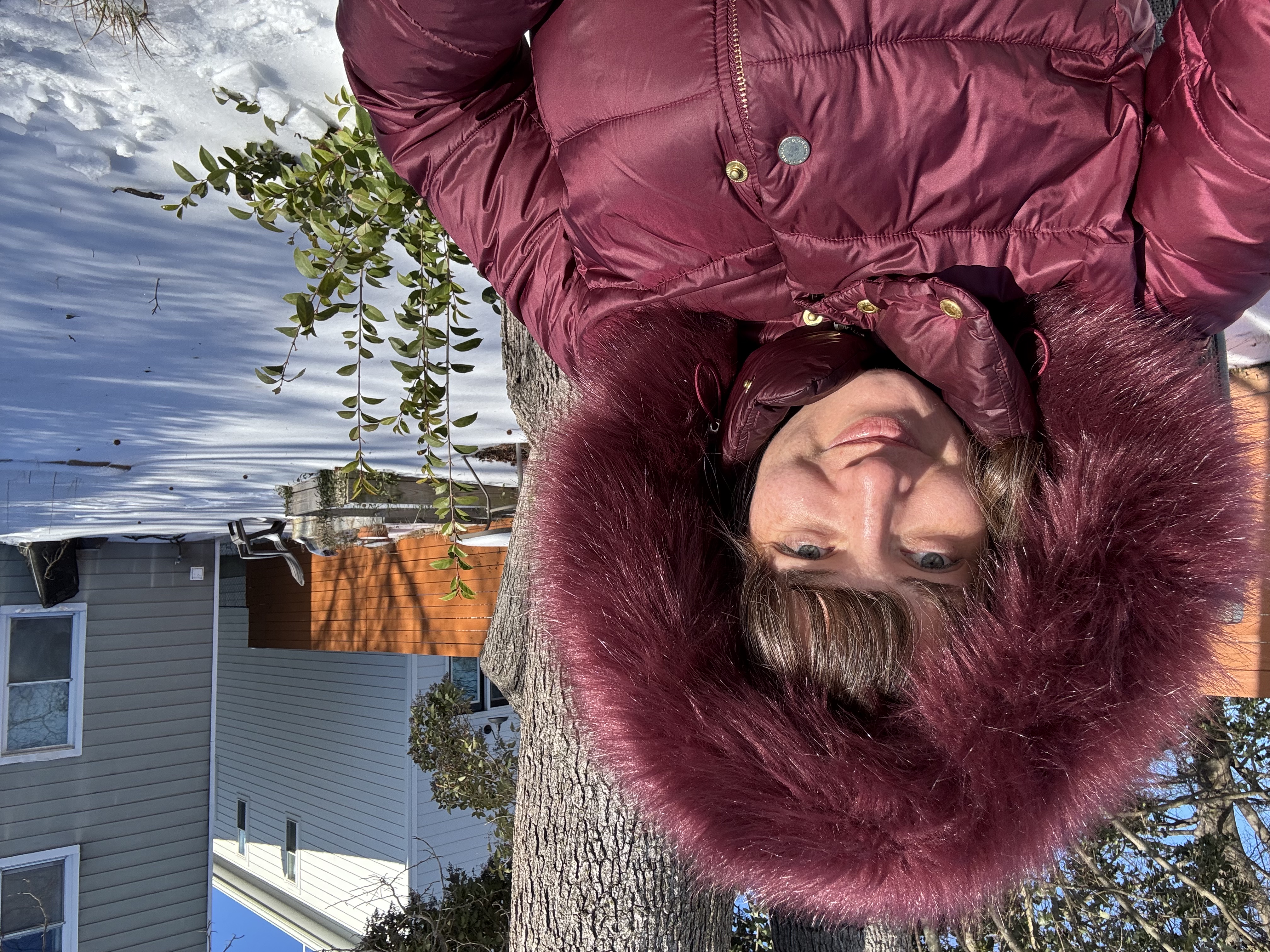
Note the lack of footprints leading to the chair I’m sitting in.
Tonight, as I lay my head to sleep, I will close out my fourth decade on this planet. “That’s halfway through life!” said my grandpa, who is halfway through his tenth decade. He sounded proud of me when he said it, and I suppose it is a kind of accomplishment. Keeping oneself alive is a grave responsibility, and it has been largely mine for the last twenty years or so. I’m proud of me, too.
Pride is only one of the feelings I have about turning forty, of course. It would not be disingenuous to say that I am also excited, grateful, and ready to rock. It is here, however, that the list of positively-connoted emotions ends. The rest float somewhere in the realm of bone-jangling anxiety and nagging (if undefined) disappointment. Positive and negative, they all mix together in a non-alcoholic cocktail of momentousness.
I say “non-alcoholic” because I’m not getting any buzz. There is something inherently sobering about this milestone. I’m beginning to think that the only way one can comprehend the passage of time is by experiencing it. You first find out about death when you’re little, but then you keep finding out about it, intermittently, for the rest of your life. And, with your full cooperation, it will hit you like a ton of bricks every time.
It’s not like I ever thought that I would live forever, or that I would retain my youthful appearance well into my elder years, as if it were some virtue particular to my personage. But thinking is not feeling, and I feel all sorts of dubious things. I feel that I can go back in time, for example. Sometimes, when I am recalling a happy childhood memory, I get the sense that I am looking forward to it, like, “wow, I can’t wait to do that part again!” I don’t know why I can’t seem to get it through my skull that time only goes one way. Maybe I am actually a genius-level physicist.
People will tell you, almost in the same breath, that age is just a number and that life begins at forty; that it matters, and it doesn’t; that you’re still young, and you’re getting old; that your best years are ahead of you, and that there are no guarantees in life. I take this to mean that I am in some sort of sweet spot, my fingertips touching two worlds, one receding and the other unfolding, and that as long as I can keep my wits about me, there is a certain untold flavor waiting just around the corner–not the sweetness of sixteen, but the bittersweetness of life as it is–and that, as long as I savor it, I won’t choke. Not yet, anyway.
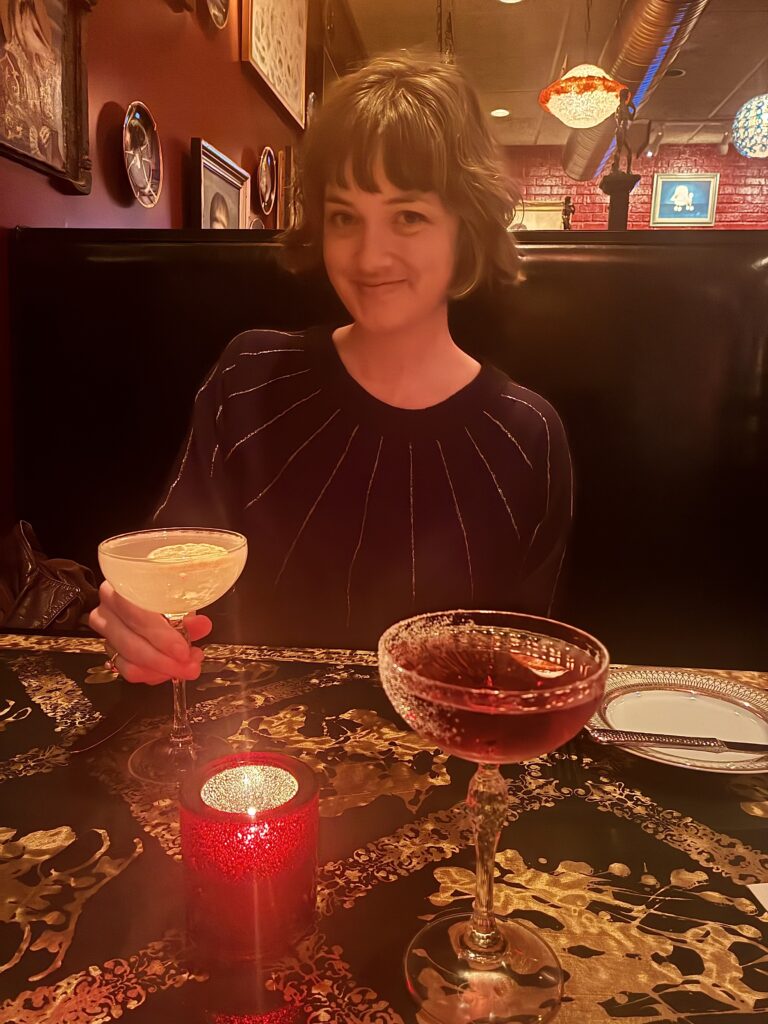
Faded beauty with “non-alcoholic” cocktail of contradictory feelings
I really should not be telling you this but the first number in my combination lock for the locker where I sometimes store my violin is 28. I say 28 and not twenty-eight because it is strictly a number in this case and not a word. It no more points to something else than does an asterisk in a suggested password. In order to remember it, however, I have assigned it a glimmer of significance in the form of a mnemonic device designed to save me from having to look it up on my phone.
At least, I think it’s still on my phone. If it is, it would be in one of the very first notes I ever saved. So rather than scroll through one-point-five decades of grocery lists and favorite quotes, I stand in front of my locker every December and perform the same ritual, left hand cradling the padlock, right hand summoning the mnemonic device from the soft, squishy recesses of my brain. An image gradually emerges over the course of about three seconds, and I catch a fleeting glimpse of the twenty-eight-year-old self my twenty-three-year-old self projected.
You see, when I was twenty-three I moved to Virginia to join the Richmond Symphony. It was December of 2009, but don’t worry; I’ll do the math for you later. My first “concert” was the annual Nutcracker run with the Richmond Ballet, during which it is common to leave one’s instrument at the hall overnight and between double performances. I was assigned a locker and given my combination on a sticky note. The second and third numbers were quite catchy (I wish I could tell you but I’ve said too much already), but I needed to invent something in order to remember the first one. Not knowing I would one day be broadcasting this information worldwide, I went with the first association that popped into my twenty-three-year-old brain: me, as a twenty-eight-year-old woman. And because a mnemonic device’s efficacy depends not so much on its logic or defensibility but on how vividly one imagines it, I went ahead and made that a sexy and sophisticated twenty-eight-year-old woman.
At that time, she was five years away. At the time of this writing, she is more than twice as far away, but in the opposite direction. She came to be and now she is not, and then some. Of course, she never came to be quite in the way I imagined her, so she still exists somewhere in the future of my past. I know this because I still see her briefly every December when my hand is hovering over the lock before I dutifully replace her with a more historically-informed image. It is a strange mental process, but it beats having to look it up on my phone, I guess.
Replacing the idealized image of my twenty-eight-year-old self with the historically-informed one is always bittersweet. It’s not that historically accurate twenty-eight-year-old me was not sufficiently sexy or sophisticated, I don’t think, and it’s not that I had dreams and goals which have since been dashed upon the rocks of cold, hard reality. It’s not even that she didn’t measure up to my expectations of success, accomplishment, or badassery. (In fact, I hadn’t the slightest intention of becoming the badass that was my twenty-eight-year-old self.) It’s just that Future Me was cardboard, and Real Me turned out to be three-dimensional, sentient, and in flux. I find this vaguely disappointing.
This yearly ritual—recall, remember, replace—produces a curious sort of whiplash. The polite phrase to use in such situations is “man, time flies”, but a more apt description of my experience would be that it feels as though someone floored it when I was twenty-three years old and hasn’t let up since, and I am pinned to the backseat by G-force, my eyes free to flit about the inside of the car and out the window at pastured cows as helpless as I am. Although my fortieth birthday is just around the corner (you’re welcome), I know we aren’t even going to slow down for the curve. Whether I choose to mark the milestone or ignore it, it will inevitably become part of the blurred scenery of my past, thanks to whomever is so heartlessly stomping on the gas, even as we speak.
(I feel like everyone who is reading this is either cringing at how old I am, smiling at how young I am, or timidly reaching across the backseat to hold hands with me.)
But take heart! I have encapsulated my experience and transmuted it into written language so that it will live on for as long as I am here to pay the annual fees.
I want to ask her. I want to know if she fights almost daily the urge to chisel away at her body rather than chiseling away at meaningful work–work that will help people, that will make a difference. But to ask would be to assume that her struggles mirror mine, that we share values, and that they are ordered similarly. Asking would seem presumptuous, precocious.
And so I will not ask. Instead I will drive to the café and order the dark mug with the swirling milk and squeeze in at the only open table, right next to a group of twenty-somethings who are very happy to be connecting with one another, despite the fact that half of them are ostensibly working, their laptops perched on the table like Battleship boards as they speak animatedly over top of them.
I’m here to try to write about this, about the audacity of a woman who does not lack the self-discipline, the intelligence, the resources, the support, or the time needed to burn the fat and tone the muscle and smooth the skin but who dares instead to direct her self-discipline, her intelligence, her resources, her support, and her time toward something else. Something beautiful, something helpful, something interesting. That might sound noble, but living it can feel tenuous, for it’s the women with the chiseled bodies who get treated like royalty.
I’m writing about it because I can’t see a way to connect face-to-face about it. (“Hey, would you like to grab coffee sometime so I can ply you with overly personal questions that you may or may not appreciate?” or “Hey, would you like to grab coffee sometime so I can overshare and possibly put you in a really awkward position?”) As soon as I begin writing, however, I start to wonder what’s to become of this emerging thought process. Will I share it on the internet? After all, how else? But the internet, in its conceit, has not been known to bother itself with the fact that my intention is merely to share my experience, to be honest, to reveal something simple yet real, something that is frankly not important enough to talk about and must therefore be written about, all so that one person might, one day, sigh with even the slightest bit of relief and say, “I’m not the only one.”
The young woman next to me–a tattoo artist, recently moved to town–is on a roll. She’s networking, getting your Insta, shaking hands, showing her work. I stare at the page and watch my thoughts as they swirl around the drain.
I’ve talked myself out of writing this so many times. I know it will be difficult, and I’m afraid it might hurt a little, but that’s not really what’s holding me back. Over the past few months, whenever a stretch of several consecutive hours has opened up and beckoned me in to explore this interior world, I’ve shied away because the patronizing adult in me admonishes the wide-eyed child in me, telling her she will one day be embarrassed by it, that she will eventually come to see how naive she was, that things only appear this way now, that her observations and impressions will become stale with time.
Now I, the wide-eyed child, would like to say to her: yes, that may be true. But tell me, what piece of writing, from poetry to scientific papers, does not fall into the category of How Things Appear Now? This will be an attempt, and I have a feeling it won’t be the last. It’s a snapshot of my current understanding, which is all any of us can ever hope to capture.
A year ago I took a sabbatical from my job as a violinist in the Richmond Symphony. For the first few months, I was still quite busy playing chamber music concerts and recitals, but for the entire month of November I decided to leave my violin in its case, resulting in the longest break I had ever taken in my life since starting the violin at age 5. I can’t say exactly why I did this or what I hoped would happen. I just had a hunch that there was this tangle of knots in my brain which needed copious amounts of time in order to loosen.
I’m going to give it to you straight. I loved Noviolinber. I enjoyed it immensely. At no point did I miss playing the violin. I read books, spent time with family, threw a baby shower for my friend, took fall walks, drank tea, took naps. I did not become a different person, nor did I experience a loss of equilibrium. I did not feel lost or empty.
When December rolled around–and with it, all the holiday gigs I’d agreed to play–I felt a familiar anxiety enter my body. The prospect of re-entering The Music World, where the peer-to-peer sizing up never ends, made my stomach drop. I felt sad that my happy, healthy, Noviolinber glow had not caused my baggage to evaporate.
After Bare Minimum December (I got my violin out only for gigs and to prepare for gigs), I got on a plane to Paris where I would be participating in a two-month-long artist residency, supposedly as a violinist, but with writing listed as a secondary discipline. Secretly, my plan was to bring the violin, essentially as a prop, but to use the time to write. (How that turned out is a story for another time, I hope.) Once again, my violin stayed in its case for the better part of a month.
Then, on February 4, I decided it was time to play a few notes. Perhaps I was ready. Perhaps I would be inspired! After warming up my wimpy fingers, I launched into whatever I could play from memory, i.e. music I had studied between the ages of 13 and 23, i.e. music with baggage. Here, miles away and years apart from these negative experiences, they still cut to the quick. It was like my violin case had acted as my Pandora’s box–none of these thoughts had crossed my mind during November or January, but now they swarmed around my otherwise empty atelier. As I observed in my journal the next day, “Not playing regularly, you lose your callouses, and not just on your fingers.”
I didn’t try again for the rest of the trip. I was troubled by the fact that, despite my lengthy supposed rejuvenation periods, I never felt any more ready to come back. I questioned the wisdom of living one’s whole life with the kind of low level anxiety that crept into my body every time I got the violin out of the case, an anxiety I’d never noticed before.
I asked myself why I tried so hard, at this stage in my life, to play the violin well–to keep getting better at it. What was simmering underneath the hours of practicing that no one was asking me to do? I suppose some people might think that there is only one kind of practicing, but there are at least two: the first involves preparing for a specific concert, and the second involves working on playing your instrument well. It is possible to get through a career in music without the second kind (once you get a job, that is). The first is always motivated by money (although there may also be deeper reasons for it), but the second must have its own motivation.
With time and the contemplative air of Parisian streets on my side, I eventually discovered that my motivation for the second kind of practice was this: although the attainment of perfection was not possible, I still held that it was honorable to pursue it throughout my earthly life. Once I articulated it in this way, I realized it had a familiar ring to it. It sounded a lot like something from my religious upbringing. Because we are human, we can never be perfect, except through Christ. That said, you have to show Christ you’re serious by trying your best to get as close to perfection as you can every day. And he will know if you didn’t try your best, so.
It had been 17 years since I’d supposedly rejected this mentality (see: Easter Someday), yet I’d continued to adopt it unconsciously in my musical life, and it had kept me locked in a constant state of self-criticism, a nagging sense of inadequacy, a life sentence of not measuring up. It gave me a certain low level anxiety I thought I’d left in the dust when I was 21.
Naturally, I rejected this mentality all over again, if only because it had enjoyed a free ride for all these years without being examined once. Perhaps, as many people seem to have concluded, this is a way to live a good life, but for now, I’m spitting it against the wall so I can get a good look at it. Denied its presumed legitimacy, it now reveals the absurd implication that I was born a bad violinist and must work to become a good one, as if all people were born bad violinists. Of course, this is true, but it is also absurd.
I returned home in late February with several weeks’ cushion before my first performance. For the first time since December, I had my pick of motivations for the first kind of practice: payment, obligation, binding social contracts, you name it. I got my violin out, did what I needed to do to prepare for the gig, then realized that I no longer had a reason to do the second kind of practice. For two or three days, I floated in this oblivion of meaninglessness, pushing bits of scales and etudes around on my plate.
I ran through some possible alternatives. I practice to…avoid humiliation? To not disappoint my teachers and parents? No, too negative. Plus, those kinds of fears practically ensure their fulfillment. What about bringing the joy of music to audiences? Sure, but let’s face it: I could still bring lots of joy to lots of people without ever doing the second kind of practice again, considering how much work I’ve already done. Ok, then perhaps it’s about doing artistic justice to the composer’s vision? Maybe. But at this point in time, I find it difficult to care enough about that to want to spend hours developing a perfectly inaudible bow change.
Finally, mercifully, the answers started coming, answers that held water, and still do. Here are my new reasons, in the order that they occurred to me.
First, doing that “deep work” kind of practice is how I make myself at home in this world. I read an interview with the poet Derek Walcott this year in which he says that “any serious attempt to do something worthwhile is ritualistic,” and the philosopher Byung-Chul Han writes that, while dwellings are how we find our home in space, rituals are how we find our home in time. Applying myself through deep concentration on a regular basis to the art of violin playing is my way of making myself at home in this world.
The second reason (as if I needed one) is that playing the violin puts me in touch, literal touch, with paradox and mystery. Why does music make sense to us at all? Why does it affect us in ways we can’t fully express? How is it that, the more I relax, the stronger and more stable I become? It’s a portal out of our overly defined, overly certain, overly verbal world, a tangible reminder of our own unknowableness, a front row seat at the meeting of limitation and possibility.
And thirdly, practicing the violin prepares me as a vessel for the New to flow through. Whether it comes as new music or as a new interpretation of old music, I want to be ready for it, and that means honing my skills. After all, what is the point of repeating all the same sounds everyone else has already made? Sounds that people will recognize and approve of? I am reminded of this chilling line, from Jean-François Lyotard’s postmodern fables: “Why all this cultural busyness, colloquia, interviews, seminars? Just so we can be sure we’re all saying the same thing.” The drive toward social acceptance certainly fuels the pursuit of sameness, but it also invites the kind of pain that cripples us as musicians to varying degrees throughout our lives. Falling short of an agreed upon standard reduces a person’s gifts to a unique constellation of defects.
I hesitate to say that this shift in thinking has changed everything for me but, by all appearances, it has. All the weird things that people say to musicians, even the weird things that musicians say to musicians, are like so much noise to my ears now. I am more confident in the strength (not to mention the existence) of my gifts, and the idea that some people may not see them or value them or approve of them doesn’t seem to faze me. I have zoomed so far out that all the little clubs that I am excluded from seem tiny and insignificant. My sense of self-worth is rooted much more deeply and widely than my status in the music world. It’s rooted in my very humanity.
Of course, I leave open the possibility that I’ll come home crying one of these days, or that a painful memory will crop up and stop me in my tracks, but I’m not ruling out that I really have been transformed in some way. As Susan Sontag writes, “an event that makes new feelings conscious is the most important experience a person can have,” and I can never un-have my sabbatical.
There is a feeling that many of us are here for the same thing. We can’t say quite what it is, but we know it must be here. Sitting in the park with a notebook, pushing the stroller with an open paperback, cutting through dense crowds with a camera slung around the shoulder. Where is it? When will I find it? Do I let it come to me? Do I even know what it is?
It’s some sort of communion. Communion with God, with the earth, with spirit, creativity, the souls of those who traipsed through these streets centuries ago. We came here because we felt something tugging while we were at home, and it seems that people have successfully found whatever that thing is while here, or because of having been here.
Me, I’m having trouble seeing and hearing beyond the steady stream of traffic beneath my window. Hemingway had a goatherd marching past his window, I have 24/7 ambulances and trucks and cars and scooters and bikes. The more I read about Hemingway, the more I realize how driven he was by ambition. And I suppose I was at that age, too. He was in his early-mid 20’s when he was “just starting into writing” here in Paris. He had been a journalist before that, but now he was devoting himself to the real stuff, the forging of a new modern style. He knew he could do it, and he was highly disciplined. He was not unaffected by rejection. Quite the contrary. But he was so motivated by this desire for recognition that it didn’t stop him.
If I had not won that job, the job I have now, when I was 23, I would have certainly continued to take auditions. But for how long? Where does determination falter? And who’s to say if it falters too early or too late? All that is beside the point for me now as I embark on this new, possibly short-lived foray of starting into writing. It’s beside the point because my determination to do so is next to nil.
Whether it’s naturally connected to being almost 38 instead of 23, or because I am doing this on my own rather than under the guidance of mentors, I can’t say. Both must have an effect. There is something intoxicating about being at college, surrounded by inspiring teachers and fellow students, with names hanging on the wall, people practicing like crazy and winning jobs left and right, and having almost no responsibilities except to succeed, and to succeed quickly.
As it is, I am spurred on only by a quiet longing to express something, an inkling that I have something to say, and a knowledge that I enjoy saying it, figuring out how to say it. That’s it. I know I enjoy it, and I suspect there is an it. What I am doing now is trying to find it. I am lucky to have people who encourage me on this path, and I suppose that adds some extra fuel when my own conviction is sagging.
Like Hemingway, I do hope to write just one true sentence, the truest sentence I could write. The truth, the naked truth, the kind of truth only dreams can speak, that is what I’m after. I stop myself, probably prematurely, from writing about family, religion, my childhood, because I want to protect people I love who believe in it with their whole heart. But my interest isn’t really in proving any of it wrong. All I can say is what I experienced, what I saw and what I see.
Perhaps I am simply on a journey to giving myself permission to walk through a door, or to walk up a narrow, spiral staircase, like the one in my dream. I had this recurring dream–still do, occasionally–where I would be making my way down a path, or through a tunnel or hallway, and suddenly I would turn a corner or look up or else just realize that, in order to proceed, I would have to fit through a terrifyingly small passageway, one where claustrophobia was inevitable. I would usually wake up at that moment in a cold sweat.
In one dream, as in many iterations, the passageway was upwards, in this case a narrow, spiral staircase. The fluorescent light flickered green, like in an old, dingy city building. I tried to walk up the staircase, but quickly realized that I couldn’t fit on the staircase with my violin on my back. That dream was pre-2020, but I’m not sure exactly when.
The most obvious meaning of the dream is that I can’t take my violin with me through the next phase of my life, my real life, if I let it unfold the way it wants to. But I suppose there could be a more nuanced interpretation, like maybe my violin can’t help me through the next phase, or the next phase is irrespective of my career. Something like that.
The challenge is to remain sensitive, to continue listening to the quiet voice inside, to not settle in too much to an interpretation of the dream. I do feel I am on the path, but I can’t see it. How is that possible? To be on a path I can’t see. The next steps revealed to me are baby ones.
For instance, what I am hearing now is that it is time to stop speed-walking through the streets of Paris. I’ve been here for a few days now. Thursday, I arrived. Friday, I shopped for essentials. Saturday, I met up with Fred and his family for crepes. Sunday, I went to the Marche Bastille and walked as far as my legs would carry me and there were still a couple of hours of daylight left.
Today is Monday. I’ve already covered a lot of ground and have a pretty good idea of the lay of the land. The voice is telling me that it’s time to slow down, actually go into one of the cafes, stand still and look at some art, have a conversation with someone. Beyond that, I don’t know, except that I knew I needed to start a document like this. I don’t love much of anything I’ve written here, but it’s a start. I can’t write about wanting to be a writer forever, but I could see how I might need to get it out in order to get to the next thing.
One idea that came up in my journaling this morning was that it would be interesting to explore ideas that coursed through this city throughout the ages. Liberty, for example. Christian mysticism, for another. You can visit the site where a woman was burned (and many people were executed after her) in the 14th century for writing a book about love and God, a book which threatened the established theology of the church. That people would die for their ideas is very humbling. These people thought long and hard about what they really thought. Me, I like to feel my thoughts. That hardly seems respectable.
This was an idea that crossed my mind yesterday. Would I respect me if I weren’t me? Probably not, and for this very reason. I only feel my thoughts, I don’t think them. Perhaps this is what makes art and creation possible, the feeling of thoughts. But on the world stage, as it were, I can’t be taken seriously unless I devote some serious thought to, well, something.
Should I try to articulate my dissatisfaction? It would hurt like hell, I’m sure. My emotions are all tangled up in there. And I run the risk of finding out that I am wrong, that I am the asshole, that I owe someone an apology. There is also a part of me that feels it would be a waste of time. I can smell that it’s rotten, I don’t need to dissect it. Where is my compass pointing now?
This is all truly disorienting. And there are two choices. Either I continue to float in space, hoping to land somewhere interesting, or I actively try to root myself in the past, in my past, bringing myself down to earth perhaps prematurely but perhaps not a moment too soon. And I don’t know which is the right thing. All I know is that I need to go easy on myself and try to enjoy this part, this part where I don’t know.
Upon my return from living in France for two months, I found it difficult to answer even the most basic questions, questions that I probably could have seen coming, questions like, “how was your trip?” and “how are you settling back in?” I remembered phrases like “it was great!” and “it was awesome!” but when it came time to elaborate thereupon, I wandered off into strange territory that neither I nor my interrogator could have seen coming.
I was freestyling, baby. Anything that came to mind was fair game: no anecdote too insignificant, no generalization too unexamined, no statement too grandiose. I was philosophizing, thinking out loud, journaling at my conversation partner. In truth, I had no idea how I was settling back in, and only an inkling as to how my trip had been.
I decided that my brain was mush and in need of organizing, lest I continue to leave my friends and acquaintances bewildered and slightly worried. I took out a small piece of paper and scrawled out the title, Modes of Being. Underneath, I made the following list:
Animal Ellen
Society Ellen
Cosmic Ellen
Animal Ellen was the part of me that needed food and water and sometimes felt scared. Society Ellen was the part of me that played a role that made some kind of sense to the people around me. Cosmic Ellen was the part of me that wasn’t really “me” at all, the part that directly experiences the universe and sometimes has thoughts about life.
The plan was that, at any given point in the day, I could determine which of these modes was appropriate for the situation, and could summon it to the fore. If I felt sleepy, Animal Ellen could take a nap. If someone asked about my trip to France, Cosmic Ellen could take a seat and let Society Ellen do the talking. Come to think of it, Cosmic Ellen could pretty much just stay seated.
Perhaps unsurprisingly, Society Ellen had a breakdown the day after establishing these delineations. We’re talking full on panic mode. I assumed I had made false distinctions and that I should instead try to be a whole, “authentic” person, thereby not putting so much pressure on Society Ellen. She obviously couldn’t handle it.
As the weeks went by, I slowly regained my ability to talk to people. Granted, I received fewer and fewer questions about my trip, but I managed to navigate the occasional query with my dignity still intact.
It wasn’t until yesterday, after having been home for more than a month, that I realized that Society Ellen’s mini-meltdown was not due to her being an imaginary prop. She was as real as anything else. No, it was due to the fact that she’d been out of commission for two months, and was a little rusty.
I didn’t need her when I was in France. I mean, I still made it a habit to wear clothes in public and not go around destroying other people’s personal property, but as far as answering for myself and making communicable sense of my existence, I was off the hook. In a foreign land, you are fulfilling your place in the world simply by being out of place. It is assumed that your life at home must look very different, and there’s no expectation that you should try to bring that life with you. In fact, a respectable traveler is one who leaves home behind and is willing to truly inhabit a different way of life, even a different persona. When else can you shed Society You?
When it came to probing questions about my life and plans and career and purpose and dreams and intentions, people generally left me alone, but more importantly, I had decided to leave myself alone. I could have easily spent those two months holding my own feet to the fire, “taking the opportunity” to take stock of my life and figure it all out, but I somehow had the good sense to know (call it being 38) that that was a recipe for crumbling if there ever was one, and I did not want to have a breakdown overseas.
I made it my sole aim to simply be in Paris. At the end of each day, I asked myself, “was I in Paris today?” If the answer was yes, Animal Ellen could sleep well, and Cosmic Ellen could dream. Society Ellen tried to bully me a couple of times, riddling me with questions like, “what are you doing here?” and “what’s your plan, Stan?” But I gave her the hand because she wasn’t even really supposed to be there.
I will be mulling over what my time in France meant to me for a good while, but for now, it feels supremely important to realize just how much time, attention, and energy I had been giving Society Ellen before the trip, and how I’d deemed Animal Ellen a nuisance and Cosmic Ellen a luxury. After all, Society Ellen adds value, Animal Ellen is an inconvenient fact, and Cosmic Ellen adds and subtracts nothing. Post-France, however, I can see that Society Ellen is expendable, Animal Ellen is an unthinkable gift, and Cosmic Ellen is eternal.
I can see that you’re getting worried again. Let me clarify that, when I say expendable, I do not mean disposable. I mean it in the following sense, the Oxford’s English sense: of little significance when compared to an overall purpose, and therefore able to be abandoned.
After spending most of the day nursing an acute sense of failure, it suddenly occurred to me that I had only the vaguest idea of what it was I was failing at. Initial investigations into the subject pointed to some pretty grandiose visions, so naturally I assumed that if I could just get my expectations out in the open, we could all have a good laugh and I could go home. I began listing them as they came to me. I, Ellen, expect myself to:
Develop a deep understanding of the human condition
Learn about what various cultures, religions, and philosophers have made of it
Note the physical and material effects those ideas had/are having on the world
Read all the books, see all the art, listen to all the music, and learn about the ideas and cultures that birthed them
Really see the culture I grew up in (20th-21st century American/Pacific Northwest/Seventh-day Adventist/Suzuki method/classical music), understand what contributed to it historically, and recognize how I have been shaped by it
Fully synthesize/digest/process all of the above information, hold it in my heart and mind, and respond sensitively and creatively and in a way that only I can or will.
This should sound impossible, if not for any one human, then at least specifically for me. I’ve read books which pertain to these topics, but my brain seems incapable of retaining such information. I could not tell you today what the main takeaways of those books were, so to think that I could amass the amount of knowledge described above is laughable.
Yet I must confess that, when I read over the list, I get really excited. The impossibility of it doesn’t scare me off, for some reason. One can imagine that all artists, philosophers, and scientists have felt similarly called out beyond themselves. They stretched and gave us the world we have today.
I’d expected to discover that my expectations had been heaped upon me by society, and that simply naming them would rob them of their power over me. I thought I would look at them and say, “Ha! Patriarchy much?” Or, “Ha! Puritanical work ethic much?” But instead, I discovered that I quite like my expectations for myself. I am beginning to wonder if they might actually be desires, not expectations.
What is funny about all of this is that something like 0.5% of my daily life is spent pursuing these goals, so I’m not actually failing because I’m not actually trying. Maybe the desire is to understand, to synthesize, to respond, and the expectation is to try. I do think I might have picked that one up somewhere.
The meaning and mattering of music is a slippery thing. Now you see it, now you don’t. When you see it, there could be nothing more magnificent. When you don’t see it (and you’re a professed musician), it is mildly discomfiting at best.
I’m not sure how common it is to lose heart in this way. It’s not something we talk about. In fact, there are many subjects considered to be taboo in musician circles, a whole slew of topics swept under the rug of We Should Be So Grateful. I do know of a couple of musicians who have voiced their discomfort with the idea of performing for some of the most privileged people in our society when we are faced with so many urgent crises of climate, hunger, violence, and all manner of suffering that humans absolutely could do something about.
For whatever reason (personal shortcomings, obviously), that particular darkness hasn’t come for me. No, my recurring dark night of the soul is the dreadful feeling that we musicians are mere participants in a system that makes busy people even busier.
Maybe that sounds crazy to you. Outrageous, even. Or maybe you think it’s a huge bummer and I should keep such negative thoughts to myself. Or maybe you disagree with me and would like to insist that music does more than just make you busier, and that you actually do enjoy concerts and don’t see them as yet another obligation in your calendar. But there’s no need to talk me off the ledge. As uncomfortable as this feeling is, I don’t view it as a thought to be expunged or educated into something more palatable. I think it’s trying to tell me something.
Ten years ago, when I first started organizing the Classical Incarnations series, I would get mad (Ellen mad) at musicians who offered to “fill time” on the program. The series was (and still is!) a free monthly event in a bar in which classical musicians from all over the city–symphony musicians, college students and professors, church musicians, freelancers, etc.–volunteered to perform a variety of music under the classical umbrella, which is quite large. Each musician or group of musicians would perform for 5-15 minutes, then the next group would take the stage. Sometimes there was a theme for the evening, sometimes not, but there was one constant: the musicians chose their own repertoire.
One of the many unintended yet beautiful things baked into this structure was the love the musicians felt for the music they presented. There was no expectation that you would perform entire works–just the movements you couldn’t wait to share. The audience could feel the sincerity. Because the series depended on people volunteering their time, we would occasionally come up a little short on the program, and musicians would say things like, “I’d like to play the 3rd and 4th movements of this sonata, but if you need to fill time I could also do the first two movements,” to which I would respond, in the manner of Batman slapping Robin, “Nobody needs to have their time filled!” I felt that our audience’s time was sacred, and that if we were going to lure them into our event, we’d better play something we cared about. This, it turns out, was counter-cultural.
To me, this is what is so dispiriting about most classical music programming. It fills in blanks. Here’s how it usually works: an organization decides that they are going to produce a certain number of concerts at this specific venue per year, and each one will be approximately this long, will be arranged like so, and will involve this size ensemble. Then the time is filled accordingly.
I wish there could be a more art-driven approach, as in: I really love this piece of music and can’t wait to share it with my community, so how can I present it in a way that brings them into the fullness of the experience? What time of day, and in what venue? Should we talk about it first, or print a program for people to read? Should we open with another piece that will help prepare them for the experience? Should we keep the program bite-sized, considering the complexity and newness of the art? How can we re-create the conditions necessary for the spark I just experienced myself?
Such an approach would be built on love–love for the music, love for the audience–which seems to be the key to meaning and mattering. But what I really find so delicious and invigorating about this approach also happens to be the reason why no institution could ever adopt it: when you aren’t feeling particularly inspired, you step aside, sit down, and shut up. At least until you have something to say.
“Without truth, without concepts, reality disintegrates into a noisy heap.”
Possible reasons why I’m in such a good mood today:
I started taking vitamin D three days ago on a whim and it has finally built up in my system enough to enhance my mood significantly. (Totally unscientific, I did not even bother to google that)
The skies are cloudy and gray, which puts me in the mind of my Oregonian youth.
I accidentally didn’t leave the house for almost two days straight.
I sobbed, wept, and whimpered last night.
I opened a letter yesterday that said my health insurance would cost approximately twice as much as I was anticipating during my sabbatical year, leading me to sit in stunned silence on the couch and repeat, à la Gob Bluth, “I’ve made a huge mistake.” (Totally unrelated to the crying, ahem)
I drank too much wine last night. (Totally unrelated to the health insurance thing, ahem)
I drank too much coffee this morning. (Totally unrelated to the wine thing, ahem)
In other words, nothing really makes that much sense. I should be feeling terrible, but instead I feel calm, light, free, optimistic, pleased, inspired…happy. I’ve felt this way all day, and so far, no crash. I can think of no explanation. There clearly isn’t one. Even the most desperate influencer wouldn’t try to sell those 7 reasons as a recipe for happiness (surely!). No, this is a feeling that can only be noticed and appreciated, not attributed. As Kurt Vonnegut taught me to do shortly after he died in 2007, I can only stop and say, “If this isn’t nice, I don’t know what is.”
If I’m the only person responsible for my own happiness, well, I’ve got some questions.